Krzysztof Penderecki, one of the most outstanding composers of the 20th century, had a unique approach to notating his musical ideas. His work was characterized by innovation and experimentation with sound, which was reflected in his working methods, including the structure and form of his notes.
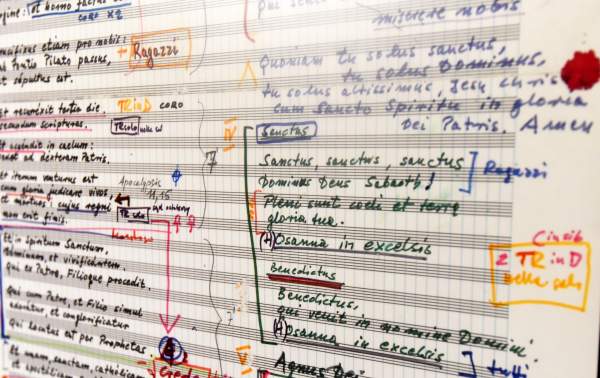
Penderecki often used non-standard notation techniques, resulting from his innovative approach to composition. Instead of traditional forms of musical notation, he employed individual solutions that allowed him greater creative freedom and experimentation with sound and musical texture. He used to carry a notebook with him, in which he wrote down various musical motifs, enabling him to capture inspiration and ideas that could appear at any moment. Such a notebook allowed him to spontaneously note thoughts and later develop them into larger musical forms.
His creative process often began with sketching a formal plan of the composition, which gave him a structure within which he could freely experiment with sound. An example of this is his work on the “St. Luke Passion,” where he first created a formal sketch and then wrote fragments of the piece in a non-linear manner, filling in the previously created general form.
Penderecki’s musical notations often contained unusual symbols and graphic signs, which were the result of his search for new sound effects and techniques of sound production. This type of notation was so unusual that it was sometimes misinterpreted, as in the case of the score for “Threnody to the Victims of Hiroshima,” which was detained by customs services on suspicion of containing encrypted information.
Penderecki did not limit himself to traditional musical notation but also used colors to notate sounds. This approach could have stemmed from his curiosity and desire to explore the world of sound, as well as from the need to shock listeners and transcend the boundaries of conventional music.
At the European Centre for Music in Lusławice, one can see a gallery of Penderecki’s manuscripts, which includes his personal notes, sketches, and objects such as crayons he used to write his works. This exhibition provides a unique insight into the composer’s creative process and his approach to musical notation.
Benefits of drawing inspiration from Krzysztof Penderecki’s notes:
- Experiment with form: Penderecki often used unusual symbols and graphic signs in his musical notes. He would encourage experimenting with various forms of notation that can help capture and develop ideas in a more intuitive and personal way. Don’t be afraid to use colors, drawings, or diagrams to better express your thoughts.
- Remain open to new ideas: Penderecki was known for constantly seeking new sounds and sound effects. It’s worth being open to new ideas and not being afraid to try things that may seem unusual or unconventional.
- Ensure structure and planning: Although Penderecki often experimented, his works were well-organized and had a thoughtful structure. It’s worth starting with a general plan or sketch that will help organize thoughts and facilitate the development of ideas into more complex projects.
- Seek inspiration from various sources: Penderecki drew inspiration from many fields, including literature, history, and even nature. Seeking inspiration outside one’s main field can enrich the creative process and lead to the discovery of new perspectives.
- Keep notes as a tool for reflection: Notes can and should serve not only to record ideas but also as a tool for reflecting on one’s own creative process. Regularly reviewing and analyzing your notes can help identify patterns and areas for further development.
 Myśli zapisane